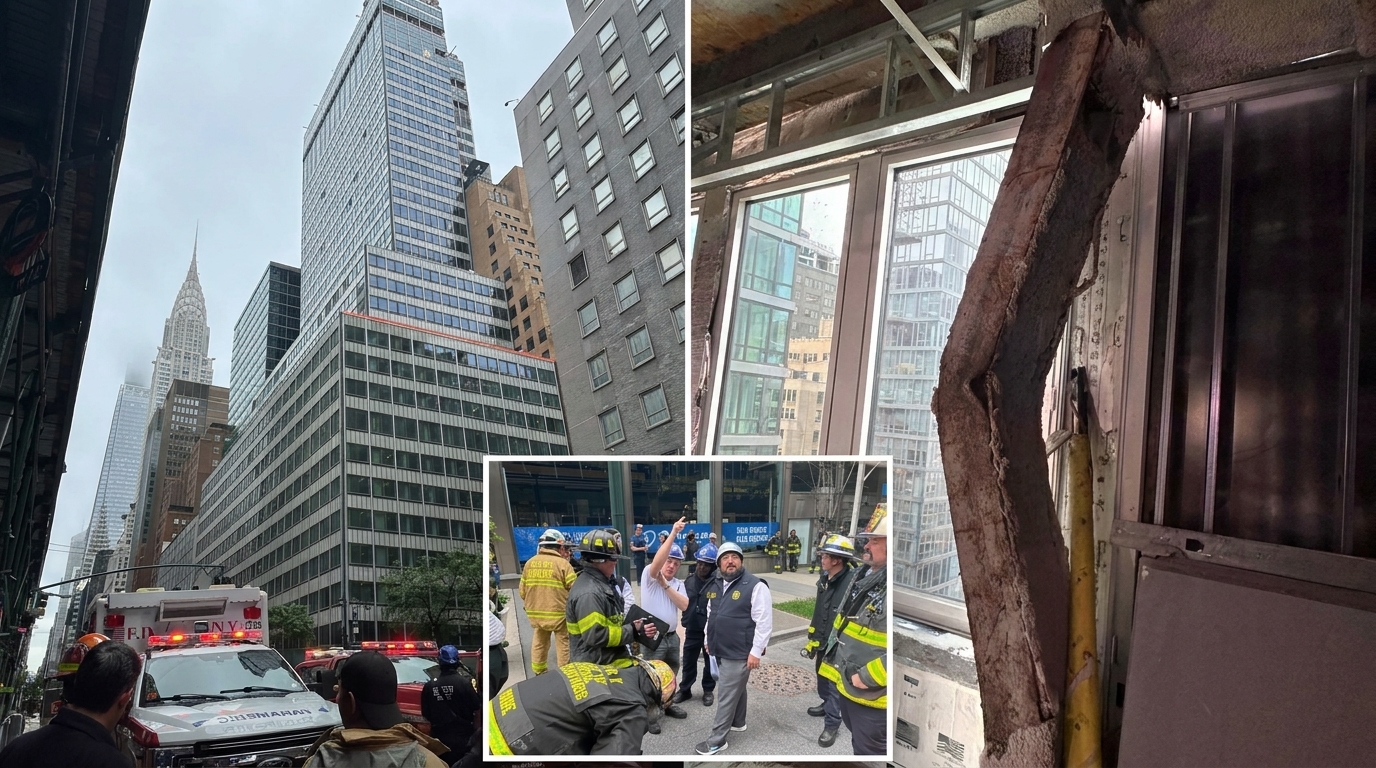
manhattan building collapse scare: 7 facts about the pfizer tower that shut down midtown
A 37-story Manhattan skyscraper triggered one of the most dramatic emergency responses in recent New York City memory this week, after structural steel columns began visibly buckling on the building’s 21st floor. The manhattan building collapse scare forced the evacuation of nine surrounding structures, including a school with roughly 400 children, and shut down a major Midtown traffic corridor for days. Here is everything confirmed about what happened.
what actually happened tuesday morning
Around 8 a.m. Tuesday, construction workers inside the former global headquarters of pharmaceutical giant Pfizer, located at 235 East 42nd Street, noticed cracks forming inside the building. Within a short time, officials say two structural support columns on the 21st floor began visibly buckling. The New York City Department of Buildings described the damage as visually resembling “bending arms.” Bricks began falling from the building into the street below, and workers self-evacuated the site.
why the building was being renovated in the first place
The manhattan building collapse scare unfolded at a site undergoing a massive transformation. The 1970s-era office tower, formerly Pfizer’s global headquarters, is being converted by developer MetroLoft into more than 1,600 luxury residential units, a project the developer describes as the largest office-to-residential conversion in New York City’s history. The building sits in one of Manhattan’s busiest corridors, roughly a block from the landmark Chrysler Building and directly between Grand Central Terminal and United Nations headquarters.
how officials responded
New York City Mayor Zohran Mamdani described the situation as “an extremely serious situation” during a Tuesday afternoon press conference, noting that the building had continued moving even after city officials arrived on the scene. FDNY Fire Chief John Esposito explained that officials were concerned about the possibility of a “localized collapse” rather than the entire structure coming down, given that the building’s steel frame construction limits the risk of a full collapse. “The building has continued to move since we have been on scene,” Esposito said Tuesday. “It does mean it is not yet stable.”
Nine nearby buildings were evacuated as a precaution, including a school with approximately 400 students, according to Mayor Mamdani. A nearby hotel, the Hampton Inn Manhattan Grand Central, evacuated guests mid-morning, with some hauling luggage out of the building as the situation unfolded. New York Governor Kathy Hochul posted on social media that state government “stands ready to provide any assistance needed.”
what the developer says caused it
Nathan Berman, managing principal and founder of MetroLoft, the firm converting the building, told the Wall Street Journal that the manhattan building collapse scare was likely caused by additional weight added during the project’s upper-floor expansion. “This additional load that we put on those floors caused those two particular columns to collapse,” Berman said. “Why those particular two columns and nothing else? We don’t know, we’re investigating that.” Separately, Berman told the New York Times the incident was “nothing more than a typical construction mishap,” and insisted the building’s overall structural integrity remained sound, describing 95 percent of the structure as “sound and intact.”
the building’s troubled safety history
Department of Buildings records reviewed following the manhattan building collapse scare show the project has previously been fined for multiple safety violations, including incidents involving falling glass and metal from the building, as well as an incident in which a construction worker fell from a ladder. A separate lawsuit alleges a construction worker suffered a “grave injury” at the same site last year, though MetroLoft has denied the allegations contained in that suit.
how the stabilization effort unfolded
By Tuesday evening, NYC Department of Buildings Commissioner Ahmed Tigani reported that emergency jacks had been installed and new steel supports were being added to stabilize the structure’s weakest points, with a third-party structural engineer brought in for an independent assessment. Officials said they had inspected the 21st floor directly and felt confident that emergency stabilization work was succeeding. By Wednesday, crews had installed temporary shoring and beams spanning floors 18 through 23, working progressively downward toward the 9th floor throughout the following days.
where things stand now
By Wednesday, officials reported the building had shown no additional movement since Tuesday morning, allowing many evacuated tenants and residents to return to nearby buildings. Portions of 42nd Street reopened to traffic in both directions, though East 43rd Street between Second and Third Avenues remained closed, and five buildings remained under vacate orders as the stabilization and investigation efforts continued. No injuries were reported throughout the incident, and all construction workers were accounted for. Mayor Mamdani noted that office-to-residential conversions like this one remain part of the city’s broader strategy for addressing New York’s housing affordability crisis, even as the manhattan building collapse scare raises fresh questions about oversight of large-scale conversion projects.
Sources: NBCNewYork.com, CNN.com, NBCNews.com, FoxNews.com, ABC7NY.com, Fox5NY.com July 7 to 8, 2026