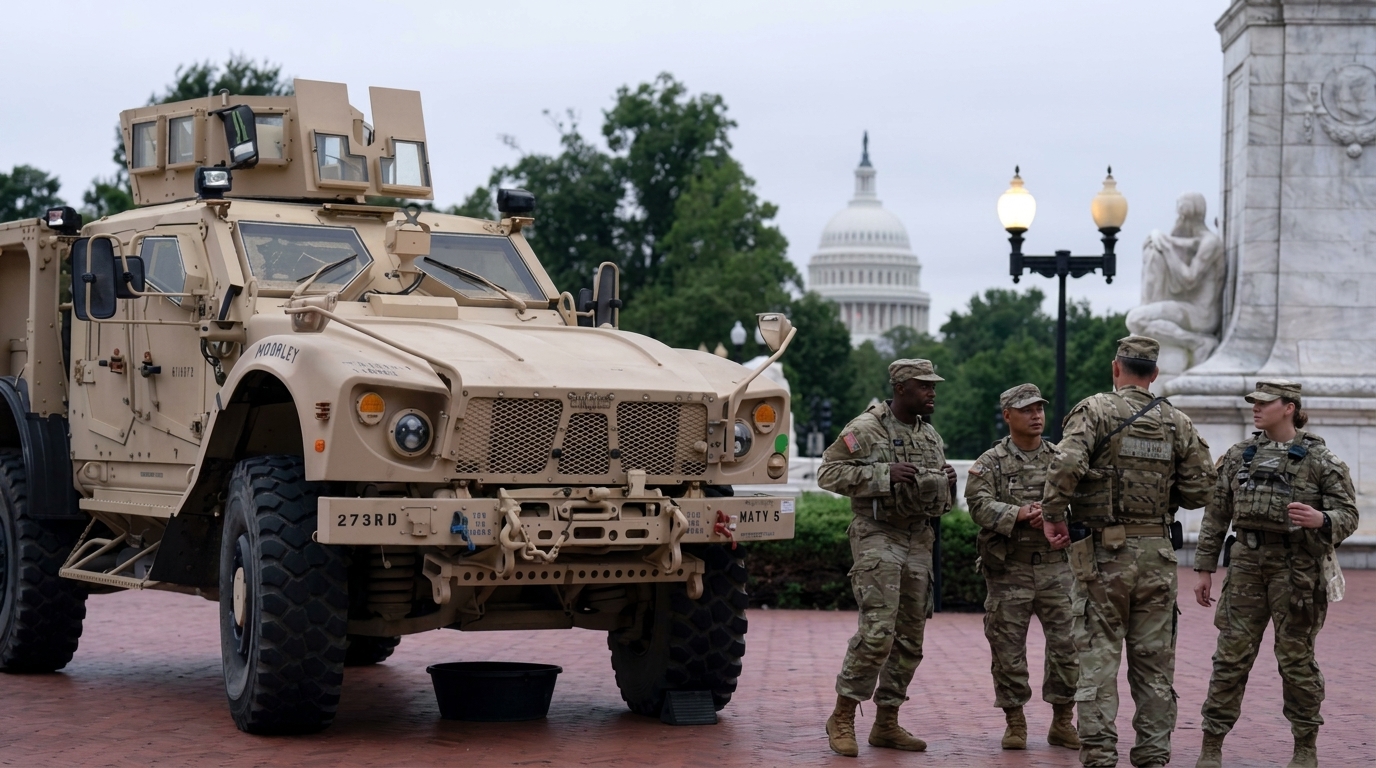
The National Guard deployment in DC has just been extended again, and this time it’s set to last through Inauguration Day 2029, the Pentagon confirmed this week. What started as a temporary emergency response to crime in the nation’s capital has now become the longest continuous National Guard deployment in U.S. history, with no clear end date beyond a presidential decision to call it off early.
How the National Guard Deployment in DC Began
The National Guard deployment in DC dates back to August 2025, when President Trump declared a “crime emergency” in Washington and launched what officials called the D.C. Safe and Beautiful Task Force. The declaration came even though violent crime in the city had actually hit a 30-year low at the time. The formal emergency order expired within a month, but the National Guard deployment in DC never really ended, instead getting extended repeatedly over the following year.
How Big the Mission Has Gotten
What began as a modest presence has grown substantially. The National Guard deployment in DC now involves nearly 5,000 troops pulled from more than 20 states, roughly double the earlier troop count, as part of what officials are calling a “summer surge” tied partly to events around the nation’s 250th anniversary. According to a Congressional Budget Office estimate, the National Guard deployment in DC is now costing taxpayers more than $3 million per day.
What the Research Actually Shows
Supporters and critics of the National Guard deployment in DC disagree sharply over whether it’s actually working. President Trump has repeatedly pointed to falling crime numbers as proof the mission is a success. But two separate studies released this month tell a more complicated story. Researchers at the nonpartisan Niskanen Center found the National Guard deployment in DC led to a 24% drop in opportunistic crimes like car theft and break-ins, but had no measurable impact on violent crime such as robbery or homicide. A separate analysis from the Center for American Progress concluded the recent crime decline in the city started before the deployment began and likely would have continued regardless. The White House pushed back on that second study, calling it “partisan hackery.”
Why Some Officials Are Uneasy
Beyond the crime statistics, the extended National Guard deployment in DC has raised broader concerns among legal experts and former military leaders. Elizabeth Goitein of the Brennan Center for Justice pointed out that describing something as an emergency loses meaning once it’s expected to last two and a half more years. Earlier this month, 19 former senior defense officials who served under presidents from both parties sent a letter praising Democratic governors who declined to send their own states’ Guard troops to the capital, warning that using the Guard for routine local policing represents a troubling departure from the tradition of keeping the military separate from domestic law enforcement.
Why DC Is Different From Other Cities
Washington occupies a unique legal position that makes this extended National Guard deployment possible in a way it wouldn’t be elsewhere. Because the city isn’t a state, its National Guard reports directly to the president rather than to a governor, unlike deployments Trump has attempted in cities such as Memphis, Los Angeles, Portland, and Chicago, several of which were slowed or blocked by legal challenges. The Supreme Court ruled in December that the president lacked sufficient justification to federalize the National Guard in Chicago specifically, a decision that has made similar moves in other cities considerably harder to pull off.
What Happens From Here
For now, the National Guard deployment in DC is locked in through Inauguration Day 2029 unless the president decides to end it sooner. Troops continue to patrol areas including the National Mall, Metro stations, and neighborhoods throughout the district, a presence that has become a fixture of daily life in the capital whether residents support it or not. Whether public opinion shifts as the deployment stretches on, or whether new legal challenges emerge, remains one of the more closely watched storylines of the president’s second term.