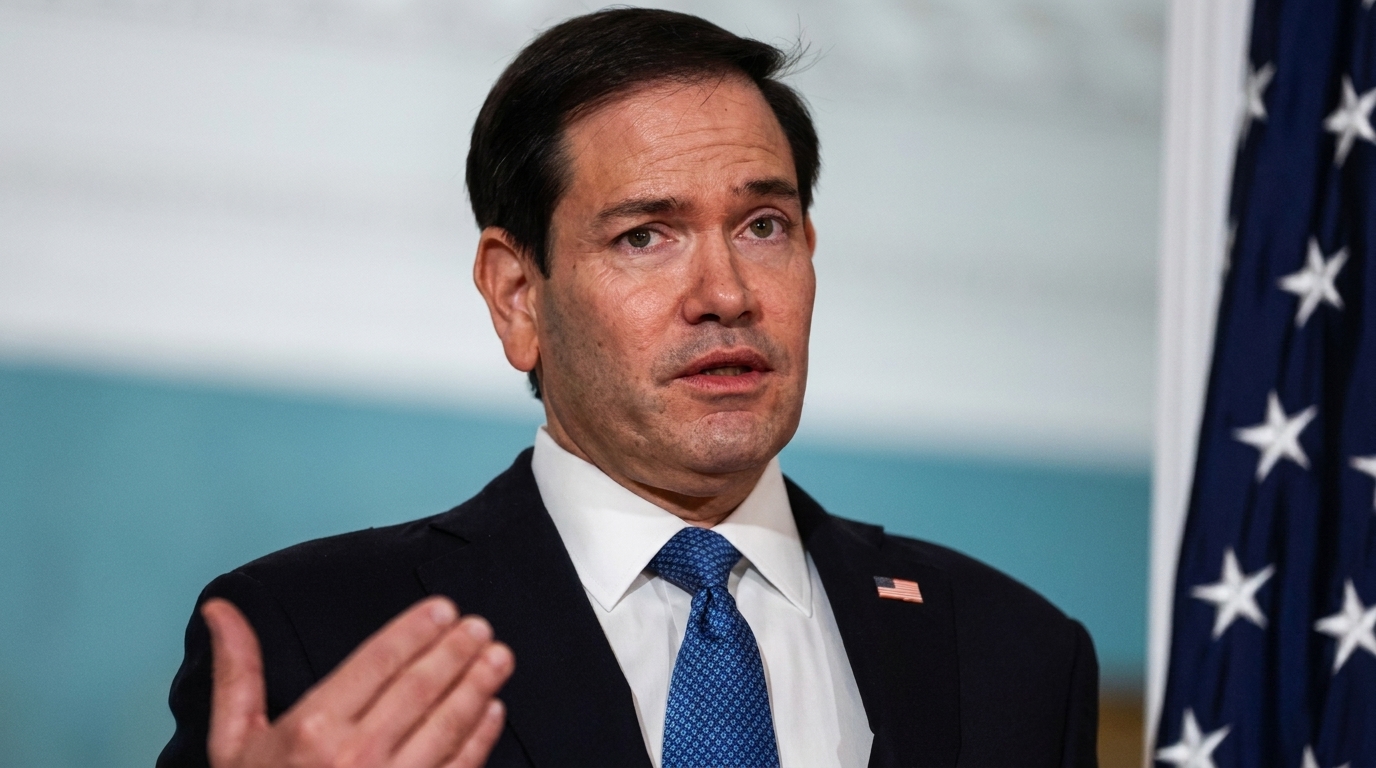
The Rubio left-wing terrorism summit held this week at the State Department has become one of the most talked-about foreign policy moments of the summer, bringing together officials from more than 65 countries to discuss what the Trump administration calls a rising global threat of left-wing political violence. Secretary of State Marco Rubio opened the Rubio left-wing terrorism summit by declaring “it is time to crush this evil forever,” setting an unusually forceful tone for what was officially billed as a “Ministerial on the Resurgence of Political Terrorism.”
Who Attended and Why It Grew
The Rubio left-wing terrorism summit was originally planned for around 60 countries but expanded to as many as 67 delegations after what the State Department described as “overwhelming interest” from nations wanting to join. Attendees came largely from Europe and Latin America, alongside representatives from Southeast Asia and other regions. Notable figures in the room included FBI Director Kash Patel, White House adviser Stephen Miller, Treasury Secretary Scott Bessent, and Israeli Foreign Minister Gideon Saar, underscoring how central the Trump administration considers this issue heading into an important political season.
What Rubio and Other Officials Said
Rubio used sweeping language throughout the Rubio left-wing terrorism summit, describing radical leftism as “a poisonous resentment cloaked in the language of equality and justice” and arguing that global counterterrorism doctrine has had a “blind spot” when it comes to violence from the political left. He drew a pointed contrast between how attacks by neo-Nazi groups versus self-described Marxist revolutionaries have historically been characterized, arguing the latter have too often been excused as legitimate political expression. Treasury Secretary Bessent added a personal note during the summit, referencing what he described as an assassination attempt against him by an “addled left-wing activist.”
The Personal Angle Behind Rubio’s Focus
Part of what has drawn attention to the Rubio left-wing terrorism summit is how personally the Secretary of State has framed the issue. Rubio, the son of Cuban immigrants who arrived in Miami in 1956 before Fidel Castro’s rise to power, told attendees that Cuban intelligence and ideological networks “helped to build the far left in our country and in our hemisphere.” That framing connects his family’s own history directly to the broader argument he made throughout the summit, that left-wing political violence represents a distinctive and coordinated international threat rather than a series of isolated incidents.
Concrete Steps Coming Out of the Summit
Beyond the rhetoric, the Rubio left-wing terrorism summit produced some tangible policy discussion. Treasury Secretary Bessent specifically highlighted financial sanctions as the administration’s primary tool going forward, noting that targeting the financial networks of left-wing groups and their supporters is, in his view, the most effective way to disrupt their activities. This builds on a move made in November, when the State Department designated four antifa or anti-fascist groups in Europe as foreign terrorist organizations, a designation that allows the U.S. government to freeze assets, criminalize material support, and block members from entering the country.
What the Data Actually Shows
Independent of how officials characterized the threat at the Rubio left-wing terrorism summit, the underlying statistics tell a more complicated story. A report from the Center for Strategic and International Studies found that as of July 2025, left-wing terrorism attacks had outnumbered far-right attacks for the first time in more than 30 years. However, that finding reflects a very low historical starting point for left-wing violence combined with a decline in far-right incidents, rather than a dramatic overall surge. From 1994 through 2000, the U.S. averaged just 0.6 left-wing terrorist incidents annually compared to 20.6 on the far right. From 2016 through 2024, that gap narrowed to roughly four incidents per year on the left versus 22.7 per year on the right, meaning far-right violence has remained substantially more frequent throughout the period the CSIS report covers.
How Critics Are Responding
Civil rights organizations and some commentators have pushed back hard against the framing used throughout the Rubio left-wing terrorism summit, arguing the underlying data doesn’t support treating left-wing violence as the primary terrorist threat facing the country. Critics contend the effort functions less as an evidence-based counterterrorism strategy and more as a political tool aimed at delegitimizing domestic protest movements and left-leaning organizations ahead of the November midterm elections. Rubio directly addressed this criticism during the summit, calling it “partisan fiction” and arguing that what he called “ideological prejudice” has caused governments to systematically underestimate the threat for decades.
Why the Timing Matters
The Rubio left-wing terrorism summit didn’t happen in a vacuum. It arrives amid a broader Republican effort heading into the November midterms to draw sharp ideological contrasts with Democrats, and follows a string of high-profile incidents, including assassination attempts against President Trump and the killing of conservative commentator Charlie Kirk, that officials at the summit repeatedly referenced as evidence of an escalating threat. Supporters argue these events justify treating the issue with the same urgency historically reserved for jihadist terrorism after the September 11 attacks. Critics counter that using isolated high-profile incidents to justify a sweeping international framework risks conflating individual acts of violence with organized political movements more broadly.
What Happens Next
Following the Rubio left-wing terrorism summit, expect the financial sanctions tools outlined by Bessent to become the administration’s primary mechanism for acting on this framework, building on the antifa designations made last year. Whether more countries follow the U.S. lead in formally designating left-wing groups as terrorist organizations, and how domestic civil liberties groups respond to any expansion of that approach here at home, are likely to be the two biggest storylines to watch in the months following the summit.
Sources: npr.org, foxnews.com, washingtonpost.com, thehill.com