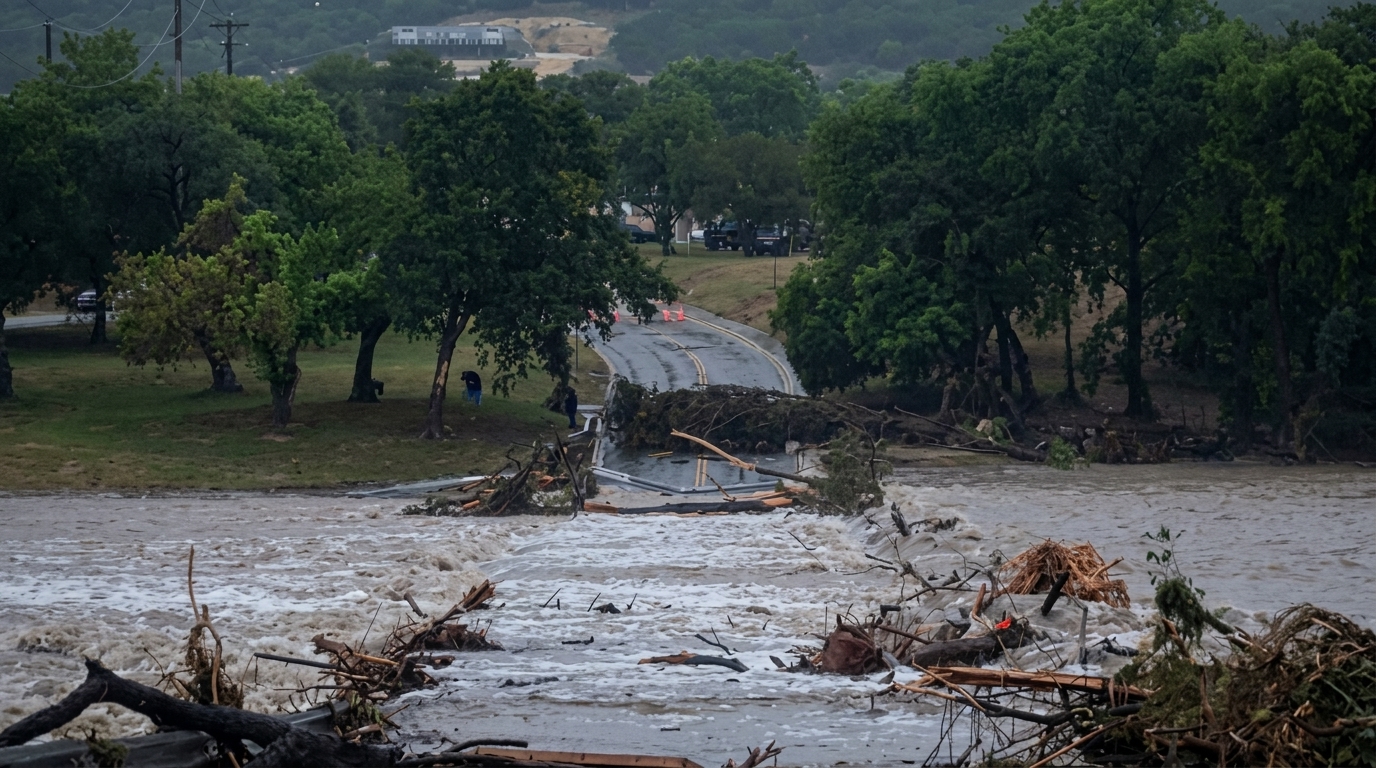
The Texas flash flooding that struck the Hill Country this week has already surpassed last year’s record river levels in some areas, arriving almost exactly one year after floods along the same waterway killed more than 130 people. Gov. Greg Abbott confirmed at least two deaths so far from this week’s Texas flash flooding, including a man swept away in his RV near Comfort and a woman swept away while driving near Uvalde, as rescue crews conducted more than 80 water rescues across the region.
How Fast the Water Rose
What made this round of Texas flash flooding so dangerous was the sheer speed of the river’s rise. National Weather Service gauges recorded the Guadalupe River climbing 32 feet in just four hours at Center Point, while a gauge at Comfort logged a 16-foot rise in only 30 minutes and a 22-foot rise within 50 minutes. By Thursday morning, the river at Comfort had reached more than 37 feet, actually surpassing last year’s record crest of 35.64 feet by roughly a foot and a half. Meteorologists said approximately 11 inches of rain fell northwest of Kerr County overnight, overwhelming the watershed almost as quickly as it did during last year’s catastrophic Fourth of July flood.
Where the Emergency Hit Hardest
This week’s Texas flash flooding stretched across at least five counties, including Kerr, Kendall, Gillespie, Uvalde, and Blanco. In Uvalde, roughly 7 inches of rain fell overnight, submerging streets and homes as the normally dry Leona River filled the city and cut off outside access, prompting more than 40 water rescues and mandatory evacuations. The City of Kerrville issued a shelter-in-place order Thursday morning as heavy rain triggered additional evacuations, and the city’s surface water treatment plant went offline due to operational issues, prompting officials to ask residents to limit nonessential water use.
A Warning System Facing Its First Real Test
One of the most closely watched elements of this week’s Texas flash flooding has been the performance of a new early warning system installed after last year’s tragedy. More than 90 River Sentry flood warning sirens, funded in part through fundraising led by the directors of Camp Mystic, were placed largely upriver of where the worst flooding hit on Thursday. Camp Mystic lost 27 campers and counselors, along with its co-owner and executive director, during last year’s flood, making the new siren network a deeply personal project for the surrounding community as officials worked to prevent a repeat tragedy.
Camp Mystic and Nearby Camps This Time Around
Unlike last year, officials confirmed that all campers along the Guadalupe River in Kerr County were accounted for and safe during this week’s Texas flash flooding. The Kerr County sheriff’s office specifically addressed concerns about camps in the area, and reports indicate at least one summer camp evacuated as a precaution as water levels climbed. Flooding near Camp Mystic itself reached about 20.5 feet, a serious flood stage but still well below the record set during last year’s disaster.
Disaster Declarations and the Emergency Response
Gov. Abbott issued disaster declarations for multiple counties affected by the Texas flash flooding, and both the City of Kerrville and Kerr County separately declared local disasters, formally requesting state and federal assistance. According to the governor’s office, more than 1,300 responders and 46 boats were deployed to support rescue operations across the region. The National Weather Service described what was moving down the Guadalupe as a “large and deadly flood wave,” a phrase officials used deliberately to convey the seriousness of the danger to residents still in the water’s path.
Why This Region Keeps Flooding So Severely
The Texas Hill Country’s vulnerability to sudden, catastrophic flooding isn’t new, and this week’s Texas flash flooding underscores why the area is sometimes referred to as “flash flood alley.” Steep terrain, thin soil, and a network of rivers and creeks that can rise dramatically after intense, localized rainfall combine to create conditions where a river can go from calm to life-threatening in under an hour. That volatility is exactly what happened at both Center Point and Comfort, where gauges recorded some of the fastest rises meteorologists have documented on the Guadalupe.
What Comes Next
Forecasters warned that additional rainfall remained possible even after Thursday’s initial flood wave passed, meaning the danger from this Texas flash flooding event wasn’t necessarily over once river levels began to recede in some spots. Flash flood warnings remained active for portions of Kerr, Kendall, and southeastern Bandera counties into the afternoon, with officials continuing to urge residents throughout the Hill Country to heed evacuation orders and avoid low-water crossings, which remain one of the leading causes of flood-related deaths in Texas year after year.
Sources: npr.org, cbsaustin.com, texastribune.org, kxan.com