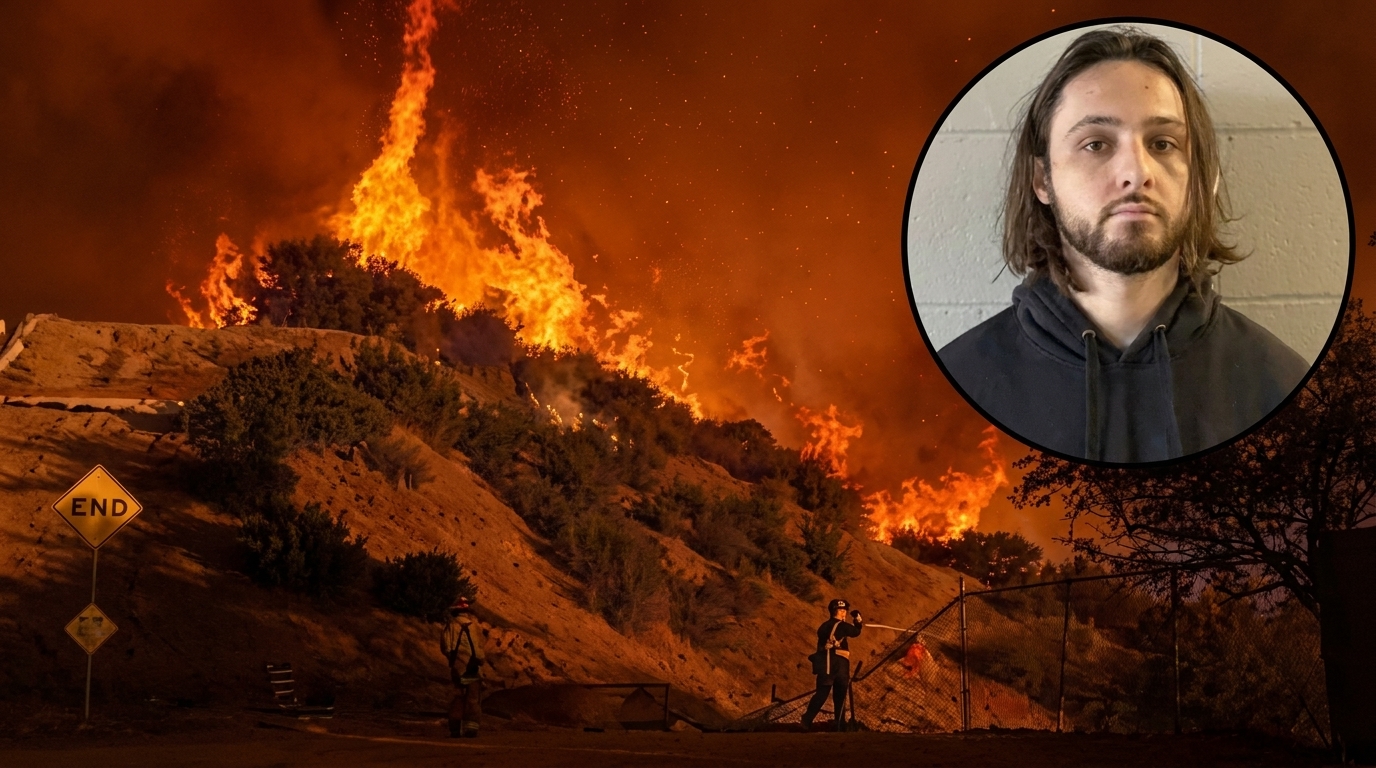
the palisades fire mistrial just ended without a verdict — here are 7 things about the case that will shock you
The man accused of starting one of the deadliest wildfires in Los Angeles history walked out of a federal courthouse on Friday without a conviction. A judge declared a mistrial in the Palisades fire arson case against Jonathan Rinderknecht after a jury of twelve people spent two days deliberating and could not agree. Ten jurors voted not guilty. Two voted guilty. The case is now back to square one.
The palisades fire mistrial is not just a legal story. It is a story about ChatGPT, Luigi Mangione, class resentment, digital evidence, and a jury that could not agree on what a fire actually proves about the man who may or may not have started it.
Here is everything you need to know.
what the palisades fire actually was
On January 1, 2025, a small fire ignited in a hillside clearing in Pacific Palisades, an affluent neighborhood on the west side of Los Angeles. Firefighters responded quickly and appeared to suppress it. What they did not know was that the fire had burrowed into underground root systems and continued to smolder.
Six days later, on January 7, powerful Santa Ana winds reignited the buried embers. What followed was one of the most destructive wildfires in California history. The Palisades fire killed 12 people, destroyed thousands of homes, and caused damage that estimates place between 35 and 45 billion dollars. As of June 2026, only 17 homes in the Pacific Palisades have been certified for reoccupancy. Rebuilding has moved at a pace that many residents describe as heartbreakingly slow.
The palisades fire mistrial means that the only person ever charged in connection with starting this disaster is, for now, a free man. According to CNN, prosecutors say they fully intend to retry the case before a new jury.
who jonathan rinderknecht is and what the prosecution said he did
Jonathan Rinderknecht is a 30-year-old former Los Angeles resident who was arrested in Florida in October 2025, nine months after the fire. He was charged with three federal counts: destruction of property by means of fire, arson affecting property used in interstate commerce, and timber set afire. If convicted on all counts, he faced up to 45 years in prison.
Prosecutors argued that Rinderknecht was a man consumed by rage and resentment in the weeks before the fire. According to the Associated Press, he had become increasingly angry about wealth inequality, his own financial situation, and a failed romantic connection. On New Year’s Eve, the woman he had asked out turned him down. He sent her angry and vile messages from a second phone. Then, prosecutors say, he drove to a hillside in Pacific Palisades a neighborhood he had associated with wealth and rejection and started a fire.
The palisades fire mistrial came after prosecutors spent weeks presenting this picture of a man building toward destruction.
the digital evidence that prosecutors called damning
The prosecution’s case rested heavily on Rinderknecht’s digital footprint, and some of what investigators found was genuinely alarming.
In the days following the December 2024 murder of UnitedHealthcare CEO Brian Thompson, Rinderknecht searched for Luigi Mangione repeatedly. He searched for “free Luigi Mangione,” “lets take down all the billionaires,” and “reddit lets kill all the billionaires.” According to ABC News, he also looked up the home address of DoorDash CEO Tony Xu and searched whether Xu had children or security cameras at his home.
Prosecutors also presented ChatGPT records showing that Rinderknecht had asked the AI system to generate images depicting fire burning through wealthy neighborhoods while rich people carried on unharmed nearby. He also asked ChatGPT directly: “Why am I so angry all the time?”
His Uber passengers, who rode with him in the days before the fire, testified that he was enraged, irritable, and reckless. He ranted about hatred for political figures, fixated on Mangione, and spoke about what he saw as the crumbling of humanity.
When investigators asked him why someone might commit arson in Pacific Palisades, he said it would be out of resentment of the rich, comparing it to an act of desperation by someone who felt enslaved by wealthy people. The palisades fire mistrial hinged on whether all of this proved he actually started the fire or just proved he was angry.
what the defense said and why 10 jurors agreed
Defense attorney Steve Haney made one argument throughout the trial, and he made it clearly: the question was not whether Rinderknecht was likable or whether his views were disturbing. The only question was whether the government could prove he started the fire on January 1, 2025.
Haney said he could not have done it, because the fire was started by fireworks. Nearby residents testified to hearing explosions and seeing flashes of light near the fire’s origin that night. Haney pointed out that some of the surveillance cameras used by prosecutors were low quality and that investigators initially believed fireworks could have been the cause.
Crucially, Haney argued, Rinderknecht called 911 more than a dozen times to report the fire and stayed at the scene while firefighters battled it. Investigators never found searches for arson techniques, fire-starting materials, or any plan. The lighter found in his rental car had his DNA on it, but prosecutors could not prove it was used to start the blaze.
“No arsonist sets a fire and calls 911 for them to put it out and then waits around to be arrested,” Haney told jurors.
Ten of them agreed. The palisades fire mistrial was the result.
what the jury said afterward
After the palisades fire mistrial was declared, several jurors spoke to reporters outside the courthouse. A juror who identified herself as Syrena, 49, said she felt there were “a lot of holes” in the government’s case. “I don’t think there was enough evidence to say he started the first fire,” she said.
Another juror said the jury had actually believed it had reached a verdict on Thursday afternoon before reconvening and discovering they had not. The deadlock, they said, was genuine and persistent. No amount of additional instruction from the judge was going to change it.
what happens next
Federal prosecutors were unambiguous after the palisades fire mistrial. United States Attorney Bill Essayli posted on X that “the evidence is strong” and that the government “fully intends to retry this case before a new jury and obtain guilty verdicts on all charged counts.”
Rinderknecht’s attorney called the 10-2 verdict a “resounding defeat for the government” and said his client was “encouraged.” He described the mistrial as proof that the government had picked the wrong man as a “scapegoat.”
What is certain is that the palisades fire mistrial leaves 12 families without closure, thousands of displaced residents still waiting to rebuild, and a 35 to 45 billion dollar disaster that, for now, has no one legally responsible for starting it.
why this case was always going to be difficult
The core challenge prosecutors faced in the palisades fire mistrial was the difference between who someone is and what someone did. The digital evidence painted a picture of a man with disturbing views and violent fantasies about class warfare. But pictures of fire generated by ChatGPT and searches for Luigi Mangione do not prove a specific person ignited a specific flame on a specific hillside at a specific time.
Courts have struggled with this distinction in an era where digital footprints reveal so much about a person’s inner life. The question is not whether the thoughts are disturbing many would agree they are. The question is whether thoughts, however dark, constitute evidence of a specific criminal act.
Ten jurors in Los Angeles on Friday said they did not.
Sources: CNN, ABC News, Associated Press, US News and World Report, Fox News June 26 to 27, 2026
External links: Full CNN trial breakdown (cnn.com) | AP reporting on mistrial (apnews.com)