Few commodities shape the global economy as profoundly as oil. From the gasoline that fills your car to the plastics in your smartphone, the price of oil permeates virtually every corner of modern life. When crude oil prices spike, airline tickets get more expensive, grocery bills rise, and the cost of manufacturing goods increases across entire supply chains. When oil futures tumble, oil-producing nations face budget shortfalls while consumers enjoy temporary relief at the pump. Understanding what drives oil prices is not just a subject for Wall Street traders and energy ministers it is essential knowledge for business owners, policymakers, investors, and everyday consumers alike.
This comprehensive guide, developed by the research team at Creative Hives, examines the key forces that determine the price of oil at any given moment. The complex tradeoffs involved in balancing those forces, and the challenges that make forecasting crude oil prices one of the most difficult exercises in modern economics. Whether you are a business owner trying to plan your operating costs, an investor evaluating energy stocks, or simply a curious reader. Who wants to understand why oil prices rise and fall so dramatically, this article will give you the analytical framework you need.
What Are Oil Prices and How Are They Determined?

At its most basic level, oil prices are determined by supply and demand in global markets. Yet this simple explanation hides a far more complex system. Geopolitics, financial speculation, technological change, environmental policy, and macroeconomic cycles all influence prices at the same time.Crude oil is priced in US dollars per barrel. One barrel equals 42 US gallons, or about 159 liters. The two main benchmark grades are West Texas Intermediate (WTI) and Brent Crude. WTI is the primary reference price for oil produced in the Americas. Brent Crude serves as the benchmark for oil traded in Europe and much of Asia.These benchmarks usually trade within a few dollars of each other. However, the price gap can widen during supply disruptions or infrastructure constraints.
Oil futures are standardized contracts traded on exchanges such as NYMEX and ICE. They require the buyer to purchase, and the seller to deliver, a specific quantity of oil on a future date. The price is agreed upon in advance.Futures markets perform two key functions. First, they allow producers and consumers to hedge against price risk. Second, they reflect the collective expectations of thousands of market participants.For this reason, today’s futures price is often viewed as the market’s best estimate of future oil prices.
The Supply Side: OPEC, Shale, and Production Decisions
No single factor influences crude oil prices more consistently than decisions about how much oil to produce. On the supply side, the dominant force for more than five decades has been the Organization of Petroleum Exporting Countries, or OPEC. The group was founded in 1960. It later expanded into OPEC+, which includes Russia and several other non-OPEC producers.Together, these countries control about 40% of global oil production. They also hold an even larger share of proven oil reserves.
When OPEC+ decides to cut production, prices usually rise. A clear example occurred in April 2020, when the group sharply reduced output after the COVID-19 pandemic caused demand to collapse. Lower supply helped push oil prices upward.The opposite can also happen. When member countries increase production or exceed their quotas, prices often fall.Internal politics within OPEC+ are complex. Member states have different fiscal breakeven prices. This is the oil price they need to balance their national budgets. They also differ in production capacity and strategic priorities. These differences often make collective decisions difficult.
The U.S. Shale Revolution and Its Market Impact
The rise of U.S. shale oil production over the past two decades has reshaped the global oil market. Through hydraulic fracturing (fracking) and horizontal drilling, American producers unlocked large reserves of tight oil that were once inaccessible. This shift transformed the United States from a major oil importer into the world’s largest oil producer by the late 2010s.Shale production introduced a new dynamic into global oil markets: a more flexible supply response. Traditional oil projects often require years of planning and billions of dollars in upfront investment. Shale wells, by contrast, can be drilled and brought online within months.
Because of this flexibility, shale producers respond quickly to price changes. When oil prices rise, U.S. shale companies usually increase drilling activity. The additional supply then helps slow further price increases.Analysts sometimes refer to this effect as the “shale governor.” It acts as a natural cap on prices. When prices climb too high, new shale production enters the market and pushes them back down.
The Demand Side: Economic Growth, Energy Transition, and Seasonal Factors
While supply decisions drive many short-term swings in oil prices, long-term trends are anchored by demand. Global oil consumption is closely tied to economic activity. When economies grow, factories produce more goods, vehicles travel more miles, and airlines carry more passengers. Each of these activities increases demand for oil products.The opposite occurs during economic downturns. Recessions can sharply reduce industrial activity and transportation. Severe crises, such as the 2008 global financial crisis or the 2020 pandemic downturn, can cause demand to collapse quickly. When this happens, crude oil prices often fall dramatically.
China and other large emerging economies have driven most of the growth in global oil demand since the 1990s. As incomes rise across Asia, Africa, and Latin America, more people enter the middle class. Many purchase vehicles, travel by air more often, and buy more manufactured goods. All of these activities increase oil consumption.Because of this influence, analysts closely watch Chinese economic indicators. These include industrial production data and purchasing managers’ index readings. Changes in China’s demand can shift global crude oil prices by several dollars per barrel.
The Energy Transition and Long-Term Demand Outlook
One of the most important long-term forces reshaping oil demand is the global shift toward cleaner energy. Electric vehicles (EVs) are spreading rapidly. Renewable power generation is expanding, and building efficiency standards are improving. Industries are also adopting more electrified processes. Together, these changes are gradually reducing the world’s reliance on oil.The International Energy Agency (IEA) expects oil demand growth to slow through the 2030s. Some analysts even believe global oil consumption could peak within this decade.
This transition creates a major challenge for oil producers and investors. If demand peaks earlier than expected, oil prices may face sustained downward pressure in the coming decades. In that case, long-dated oil futures could become less attractive.However, the pace of the transition remains uncertain. Emerging economies may follow different development paths. Infrastructure constraints could slow the adoption of electric vehicles. In addition, petrochemicals such as plastics and fertilizers represent a growing share of oil demand. These uses are much harder to replace with electricity.
Geopolitical Risk: Wars, Sanctions, and Supply Disruptions
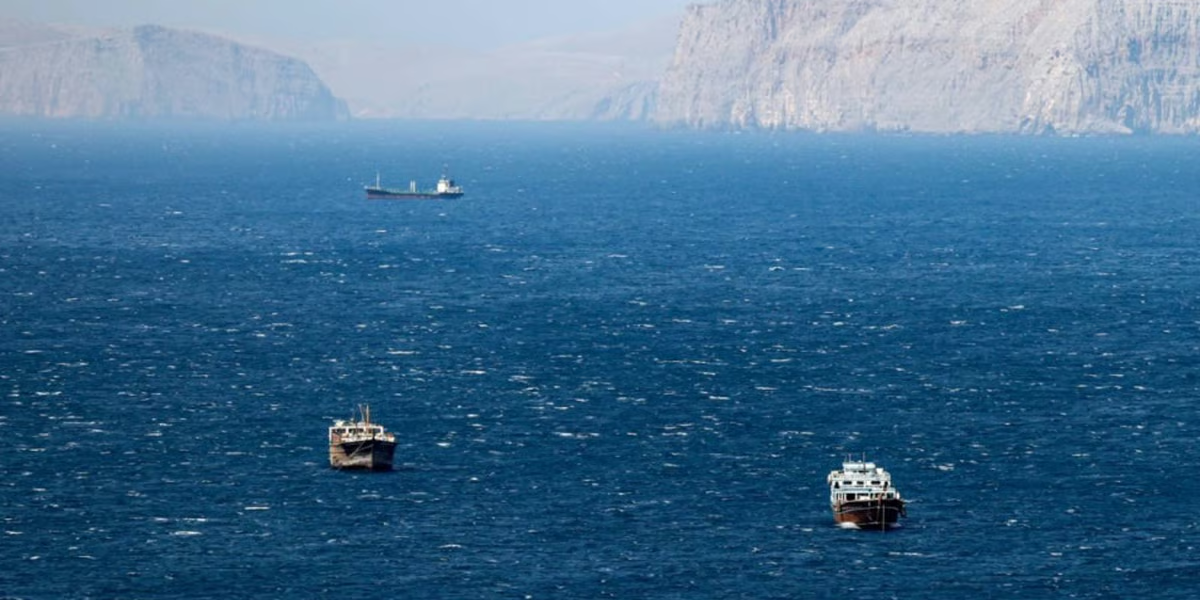
Because many of the world’s largest oil reserves are located in politically volatile regions, geopolitical events often inject sudden uncertainty into oil markets. Major producers include countries in the Middle East, Russia, Venezuela, and parts of West Africa. Conflicts, sanctions, or attacks on infrastructure in these regions can disrupt supply and push prices sharply higher.Strategic shipping routes are especially sensitive points in the global energy system. One of the most critical is the Strait of Hormuz, a narrow waterway through which about one-fifth of the world’s oil supply passes each day. Any threat to tanker traffic in this corridor can quickly trigger price spikes in global crude markets. (Business Standard)Geopolitical shocks can move prices within hours. A conflict in a major producing nation, a pipeline attack, or sanctions on a large exporter can immediately affect expectations about future supply. Markets react quickly because even a temporary disruption can remove millions of barrels of oil from global circulation.
The Russian invasion of Ukraine in February 2022 demonstrated how powerful these shocks can be. As Western countries imposed sanctions on Russia, one of the world’s largest oil exporters, Brent crude prices surged toward $130 per barrel. This was the highest level seen since the 2008 oil price spike.The crisis triggered a global effort to reroute energy flows and secure alternative supplies. Governments released strategic reserves, while energy companies searched for new sources of production. The episode highlighted how deeply global oil markets are intertwined with international politics and security.Geopolitical risk premiums are difficult to measure and even harder to forecast. Traders must estimate both the probability of a disruption and its possible scale. A small outage in a minor producer may barely move prices. By contrast, a sustained disruption in major producers such as Saudi Arabia or the United Arab Emirates could fundamentally reshape global energy balances.
For this reason, oil markets constantly monitor geopolitical developments. Even rumors of conflict near key infrastructure or shipping lanes can influence prices long before any actual disruption occurs.
The Role of the U.S. Dollar and Financial Markets
Because crude oil is priced in U.S. dollars, exchange rate movements influence global oil prices. When the dollar strengthens against other currencies, oil becomes more expensive for international buyers. This often reduces demand and pushes prices lower.The opposite occurs when the dollar weakens. Oil becomes relatively cheaper for buyers using other currencies. This tends to support stronger demand and higher prices. As a result, oil prices and the U.S. dollar often move in opposite directions.This relationship is one of the most consistent correlations in commodity markets. However, it is not absolute. Large supply disruptions or sudden demand shocks can easily overwhelm currency effects.Financial markets also play a major role in short-term oil price movements. Large institutional investors hold significant positions in oil futures and related derivatives. These investors include pension funds, sovereign wealth funds, and hedge funds.
When investors adjust their portfolios, their trading activity can influence oil prices. Changes in risk appetite, interest rate expectations, or macroeconomic forecasts can trigger large buying or selling flows. These shifts can move crude prices even when physical supply and demand remain unchanged.Interest rates influence oil markets through several channels. Higher rates raise the cost of financing oil inventories and new production projects. This can discourage investment in future supply.Higher interest rates can also slow economic growth. Slower growth reduces industrial activity and transportation, which lowers demand for oil. For this reason, oil market participants closely monitor central bank policy decisions.Monetary policy in the United States receives particular attention. Changes in interest rate expectations can quickly affect both the U.S. dollar and global financial markets. In turn, these shifts often lead to noticeable movements in crude oil prices and futures markets.
Inventory Levels and Storage Capacity: The Physical Market Signal
One of the most closely watched indicators in global oil markets is the weekly report on U.S. crude oil inventories published by the U.S. Energy Information Administration (EIA). This report provides insight into the balance between supply and demand in the world’s largest oil consumer.When inventories rise above typical seasonal levels, it usually signals that supply is exceeding demand. Excess supply tends to place downward pressure on oil prices. When inventories fall, the opposite is true. Declining stockpiles suggest tightening market conditions and can trigger price rallies as traders anticipate stronger demand.Storage capacity can also become a critical factor during periods of extreme market stress. If production continues while demand collapses, oil can accumulate faster than it can be stored. When storage facilities approach their limits, prices can fall rapidly.
This situation occurred during the early months of the COVID-19 pandemic in 2020. Global lockdowns sharply reduced travel, transportation, and industrial activity. Oil demand dropped at an unprecedented speed, while production initially remained high.As a result, storage facilities around the world began filling toward capacity. In April 2020, this imbalance produced an extraordinary event. West Texas Intermediate (WTI) crude oil futures briefly traded at negative prices.In practical terms, some producers were paying buyers to take oil off their hands. They simply had no place left to store it. The episode highlighted an important reality of oil markets. No matter how complex financial trading becomes, prices remain tied to the physical limits of storage, transportation, and refining capacity.
Environmental Policy, Carbon Pricing, and the Regulatory Landscape
Government policies related to climate change are becoming more influential in global oil markets. Environmental regulations can affect both oil demand and oil supply.One important policy tool is carbon pricing. This can take the form of a carbon tax or a cap-and-trade system. Both approaches raise the cost of burning fossil fuels. As a result, businesses and consumers have stronger incentives to adopt cleaner energy alternatives.The European Union’s Emissions Trading System (ETS) is one of the most developed carbon markets. Several countries have also implemented national carbon taxes. These policies influence energy choices within regulated economies. However, their direct impact on global oil prices has remained limited so far because large parts of the world still operate without similar regulations.
Environmental policies also affect the supply side of the oil market. Stricter rules for drilling, pipeline construction, and refinery operations can raise production costs. They can also limit where companies are allowed to explore and produce oil.In contrast, policy reversals can expand supply expectations. Governments may open previously protected land to drilling or simplify permitting procedures. Such changes can encourage new investment and increase future production potential.Regulation also shapes the flow of capital into the oil industry. Many institutional investors now face pressure to reduce climate-related financial risk. Pension funds, banks, and asset managers are responding to these concerns.Some investors have reduced their exposure to oil and gas companies. Others have tightened lending standards for energy projects. This trend is sometimes called “capital starvation.”Paradoxically, limited investment could support higher oil prices over time. If demand remains strong but fewer new projects are financed, global supply growth may slow. That imbalance could place upward pressure on prices in the long run.
The Tradeoffs: Why Managing Oil Prices Is So Complex
The previous sections described many factors that influence crude oil prices. However, examining each factor alone does not fully explain how the market works. The real complexity comes from the interaction between these forces. Policy decisions and market responses often create unintended consequences.
OPEC+ producers face a clear strategic dilemma. If they cut production, oil prices usually rise. Higher prices increase revenue for each barrel sold. However, these higher prices also encourage competing producers to expand output.This is especially true for U.S. shale companies. When prices increase, shale producers can quickly ramp up drilling. As a result, OPEC+ risks losing market share to non-OPEC competitors.The alternative is also risky. If OPEC+ increases production to defend its market share, prices may fall sharply. Lower prices can push smaller producers out of the market. At the same time, they can strain the budgets of oil-exporting countries.
Saudi Arabia faces a particularly difficult balance. The country has relatively low production costs. However, its government relies heavily on oil revenue to fund public spending.Oil-importing countries face their own tradeoffs. Lower oil prices benefit consumers and import-dependent economies in the short term. Energy and transportation costs decline, which supports economic activity.
However, very low prices can reduce investment in both domestic energy production and alternative energy technologies. When companies expect weak returns, they delay or cancel new projects.This creates a long-term risk for the global market. If investment falls too far, future supply capacity may shrink. When demand eventually rises again, the result can be sudden price spikes.At Creative Hives, we regularly analyze these tradeoffs for clients in logistics, manufacturing, and financial services. Our work focuses on how oil price scenarios affect operational costs and strategic planning.The key insight is simple. There are no easy solutions in energy markets. Every policy decision or market intervention involves accepting certain costs in exchange for specific benefits.
Forecasting Oil Prices: Why Predictions Are Notoriously Difficult
Given the many factors affecting oil prices supply decisions, demand growth, geopolitical events, financial flows, currency movements, storage levels, and policy changes it is no surprise that accurate forecasting is extremely difficult. Even sophisticated models from investment banks, energy agencies, and research institutions often fail to predict actual prices.
One reason is the prevalence of “fat tail” events. These are low-probability, high-impact occurrences that standard statistical models tend to underestimate. Examples include the COVID-19 pandemic, the 9/11 attacks, the Arab Spring, and the Russian invasion of Ukraine. Each event caused oil prices to move sharply in unexpected directions. By definition, fat tail events cannot be reliably predicted.
Another challenge is that oil markets are forward-looking. Traders constantly incorporate expectations about future events into current oil futures prices. Even if an analyst identifies a factor that will affect future supply or demand, the market may have already priced it in. This can make it difficult to profit from the insight or predict short-term price movements.
Despite these difficulties, analysts use frameworks to consider medium-term price trends. They typically create scenarios based on OPEC+ production choices, U.S. shale responses, demand growth in China and other major economies, and geopolitical risks. By outlining bull, bear, and base cases and assigning approximate probabilities, market participants can make more informed decisions. While precise price predictions remain impossible, scenario analysis helps anticipate likely ranges and risks.
The Impact of Oil Prices on Businesses and the Broader Economy
For businesses across virtually every sector, oil prices represent both a direct cost driver and a macroeconomic risk factor. Airlines, shipping companies, trucking firms, and petrochemical manufacturers face the most direct exposure. Fuel costs represent a substantial share of their operating expenses, and even modest swings in crude oil prices can have material impacts on their profitability.
But the indirect effects of oil price changes are even more pervasive. When oil prices rise significantly, inflationary pressures build across the economy as transportation costs, manufacturing input costs, and heating and cooling expenses all increase. Central banks may respond by tightening monetary policy, which raises borrowing costs and slows economic activity. Consumer confidence can deteriorate as higher gasoline prices eat into household budgets, reducing spending on other goods and services.
Conversely, sharp declines in the price of oil can act as a stimulus to oil-importing economies effectively functioning as a tax cut for consumers and businesses that consume energy. However, they simultaneously damage the economic fortunes of oil-producing regions and nations, reducing government revenues, employment in the energy sector, and investment in resource extraction.
Smart businesses do not simply react to oil price movements after the fact. They proactively manage their exposure through a combination of hedging strategies (using oil futures and other derivatives to lock in favorable prices). Operational flexibility (designing supply chains and processes that can adapt to different energy cost scenarios), and strategic planning that explicitly incorporates a range of oil price assumptions.
The analysts at Creative Hives work with service-based businesses to assess their indirect oil price exposure a factor that many companies underestimate significantly. Even firms that do not directly consume oil or petroleum products can be significantly affected by oil price movements. Through their suppliers, their customers, and the broader macroeconomic environment.
Key Metrics and Data Sources for Tracking Oil Markets
For anyone seeking to follow crude oil markets closely, a working knowledge of the key data releases and market indicators is essential. The most important include:
EIA Weekly Petroleum Status Report: Published every Wednesday, this report provides data on U.S. crude oil and petroleum product inventories, refinery utilization rates, and production levels. Inventory builds or draws relative to market expectations are among the most reliable short-term price catalysts.
OPEC Monthly Oil Market Report: Released in the second week of each month, this document provides OPEC’s assessment of global supply and demand balances, along with member nation production data. It is the primary official communication channel through which OPEC signals its market outlook and policy intentions.
IEA Oil Market Report: The International Energy Agency’s monthly report offers an independent, non-OPEC perspective on global oil supply, demand, and inventory trends. Discrepancies between the IEA and OPEC assessments are often market-moving.
Commitment of Traders (COT) Report: Published weekly by the U.S. Commodity Futures Trading Commission (CFTC), this report shows the net long or short positions of different categories of traders. In oil futures markets, providing insight into speculative positioning and potential price momentum.
Baker Hughes Rig Count: A weekly count of active oil and gas drilling rigs in the United States and internationally. Rising rig counts signal increasing investment in new production, which can weigh on future oil prices; falling rig counts suggest the opposite.
Conclusion: Navigating an Uncertain Energy Future
Oil prices are the product of an extraordinarily complex system of interacting forces supply decisions by producers large and small, demand growth driven by economic development. And undermined by energy transition, geopolitical risks that can materialize without warning, financial market dynamics, currency movements, and regulatory environments that differ across dozens of jurisdictions. No single model or framework can fully capture this complexity, and anyone who claims to predict crude oil prices with consistent precision should be viewed with healthy skepticism.
What is possible and essential for any serious business, investor, or policymaker is to develop a clear-eyed understanding of the key factors at play, the tradeoffs involved in managing them, and the range of scenarios that could plausibly unfold. A company that has thought carefully about how its operations and finances would be affected by oil at $50, $80, or $120 per barrel is far better positioned. To respond effectively to actual market conditions than one that simply assumes current prices will persist.
The energy landscape is also evolving more rapidly than at any previous point in modern history. The intersection of the oil market with the clean energy transition, digital technologies, geopolitical realignments, and changing consumer behavior will create both risks and opportunities. That are difficult to anticipate from today’s vantage point. Staying informed, maintaining analytical flexibility, and building organizational resilience are the most reliable strategies for navigating this environment.
At Creative Hives, we believe that accessible, rigorous analysis of topics like oil prices is fundamental to sound business decision-making. We hope this guide has provided you with a stronger foundation for understanding one of the most consequential forces in the global economy. As the energy transition unfolds and oil markets continue to evolve, staying informed and analytically prepared will remain one of the most valuable competitive advantages any organization can cultivate.